Blog Posts
Building an Agentic Team for an Open Source Project with Claude Code
A core engineer on MemMachine — the one who owned the Semantic Memory subsystem — left the project. The codebase didn’t grow any less complex overnight, but the human attention available to maintain it did. That’s a familiar shape of problem in any open source project, and it’s the exact shape where a well-designed Claude Code agent team earns its keep.
This post documents what I built: a 22-agent maintenance team that lives entirely inside MemMachine’s repository, coordinates via Claude Code’s experimental Agent Teams runtime, and operates under a design I can reproduce for any existing repository with real code. The agents don’t push code, don’t sign commits, don’t merge pull requests, and don’t cut releases — humans still gatekeep every consequential action. What the agents do do is the tedious and error-prone middle of software maintenance: triage, spec drafting, implementation, QA, security review, docs, dependency and upstream tracking.
Read More
Linux Kernel v7.0 is Released: This is What's New for Compute Express Link (CXL)
The Linux Kernel v7.0 release brings several improvements and additions related to Compute Express Link (CXL) technology.
Release Highlights
Linux Kernel v7.0 includes 73 commits to the CXL and DAX subsystems:
| Category | Commits |
|---|---|
| New Features & Hardware | 3 |
| Bug Fixes | 11 |
| Refactoring & Cleanup | 9 |
| Testing | 2 |
| Other | 48 |
Linux v7.0 brings focused but meaningful progress to the CXL/DAX subsystem, with the headline work centered on platform-specific address translation. The cxl/atl subsystem gains AMD Zen5 support through the ACPI Platform Runtime Mechanism Table (PRMT), enabling hardware-assisted Host Physical Address (HPA) to System Physical Address (SPA) translation on AMD’s latest server platforms. This required scaffolding across several layers: EFI runtime services preparation in cxl/acpi, new translation callback hooks, decoder locking for address translation paths, and explicit disabling of these handlers when Normalized Addressing is active — a sign the translation infrastructure is maturing toward multi-vendor, multi-mode support.
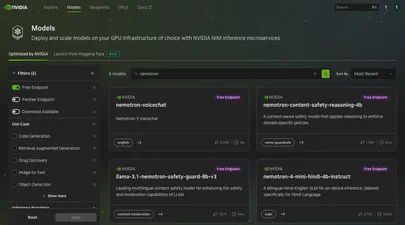
Using the API to Find Free Hosted Models on NVIDIA Builder
The NVIDIA Developer Program provides access to a wide catalog of AI models through NVIDIA Inference Microservices (NIM), offering an OpenAI-compatible API. You can browse and discover available models at build.nvidia.com/explore/discover .
If you want to find models with free hosted endpoints in the browser, you can enable the “Free Endpoint” filter
on the model catalog page. But what if you need that information programmatically – in a script, a CI pipeline, or as part of an automated workflow? The browser filter is not accessible through the API, and the /v1/models endpoint does not distinguish between free hosted models and everything else.

Linux Kernel v6.19 is Released: This is What's New for Compute Express Link (CXL)
The Linux Kernel v6.19 release brings several improvements and additions related to Compute Express Link (CXL) technology.
Release Highlights
Linux Kernel v6.19 includes 31 commits to the CXL and DAX subsystems:
| Category | Commits |
|---|---|
| New Features & Hardware | 1 |
| Bug Fixes | 4 |
| Refactoring & Cleanup | 5 |
| Testing | 1 |
| Documentation | 2 |
| Other | 18 |
Linux v6.19 is a measured release for the CXL/DAX subsystem — 31 commits spread across correctness fixes, code hardening, and targeted new functionality. The headline addition is extended linear cache (ELC) region support: regions can now be flagged to indicate they carry an ELC mapping, a prerequisite for properly managing CXL memory that participates in CPU-side cache hierarchies. Alongside the feature itself, the release includes adjustments to how ELC failures are reported through cxl_acpi, and the HBIW platform-data guard that was accidentally dropped has been restored.
Reflections and What's Next: Lessons from Building lib3mf-rs
Series: Building lib3mf-rs
This post is part of a 5-part series on building a comprehensive 3MF library in Rust:
- Part 1: My Journey Building a 3MF Native Rust Library from Scratch
- Part 2: The Library Landscape - Why Build Another One?
- Part 3: Into the 3MF Specification Wilderness - Reading 1000+ Pages of Specifications
- Part 4: Design for Developers - Features, Flags, and the CLI
- Part 5: Reflections and What’s Next - Lessons from Building lib3mf-rs
On February 4th, 2026, lib3mf-rs is a published open-source project with complete specification coverage, available for anyone to use.
Read More
Design for Developers: Features, Flags, and the CLI
Series: Building lib3mf-rs
This post is part of a 5-part series on building a comprehensive 3MF library in Rust:
- Part 1: My Journey Building a 3MF Native Rust Library from Scratch
- Part 2: The Library Landscape - Why Build Another One?
- Part 3: Into the 3MF Specification Wilderness - Reading 1000+ Pages of Specifications
- Part 4: Design for Developers - Features, Flags, and the CLI
- Part 5: Reflections and What’s Next - Lessons from Building lib3mf-rs
Understanding the specifications was one thing. Designing a library that developers would actually want to use? That was another challenge entirely. I’ve worked on many libraries over the years, and I’ve learned a lot about what makes a good library, for example the Persistent Memory Development Kit . The difference is understanding how Rust does things.
Read More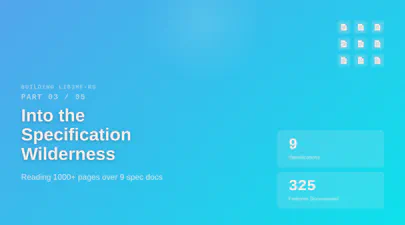
Into the 3MF Specification Wilderness: Reading 1000+ Pages of Specifications
Series: Building lib3mf-rs
This post is part of a 5-part series on building a comprehensive 3MF library in Rust:
- Part 1: My Journey Building a 3MF Native Rust Library from Scratch
- Part 2: The Library Landscape - Why Build Another One?
- Part 3: Into the 3MF Specification Wilderness - Reading 1000+ Pages of Specifications
- Part 4: Design for Developers - Features, Flags, and the CLI
- Part 5: Reflections and What’s Next - Lessons from Building lib3mf-rs
“How hard can it be? It’s just a file format.”
That’s what I thought before I started reading the 3MF specifications. After reading, re-reading, and getting AI to help summarize and dig deeper into the interpretations and understandings, I was ready to begin.
Read More
The Library Landscape: Why Build Another One?
Series: Building lib3mf-rs
This post is part of a 5-part series on building a comprehensive 3MF library in Rust:
- Part 1: My Journey Building a 3MF Native Rust Library from Scratch
- Part 2: The Library Landscape - Why Build Another One?
- Part 3: Into the 3MF Specification Wilderness - Reading 1000+ Pages of Specifications
- Part 4: Design for Developers - Features, Flags, and the CLI
- Part 5: Reflections and What’s Next - Lessons from Building lib3mf-rs
“Why not just use the existing library?”
It’s a fair question. One I asked myself many times during the early days of this project. The 3MF Consortium maintains lib3MF , a comprehensive C++ implementation used by major companies in additive manufacturing. Why build another one?
Read MoreCategories
- 3D Printing ( 7 )
- AI ( 11 )
- Books ( 2 )
- Cloud Computing ( 1 )
- Conferences ( 2 )
- CXL ( 24 )
- Data Center ( 2 )
- Development ( 2 )
- Events ( 2 )
- Hardware ( 1 )
- How To ( 35 )
- HowTo ( 1 )
- Linux ( 32 )
- Machine Learning ( 1 )
- OrcaSlicer ( 2 )
- Performance ( 2 )
- Persistent Memory ( 1 )
- PMEM ( 1 )
- Product Manager ( 1 )
- Projects ( 3 )
- Servers ( 1 )
- Storage ( 1 )
- System Administration ( 2 )
- Troubleshooting ( 4 )
- Ubuntu ( 1 )
- Vector Databases ( 1 )
Tags
- 3D Printing
- 3MF
- ACPI
- ACPI-CA
- Acpidump
- Active-Memory
- Agent
- Agent Runtime
- Agent Skills
- Agent Teams
- AI
- AI Agents
- AI Engineering
- AI Infrastructure
- AMD
- API
- Apple Silicon
- Arcade
- Artificial Intelligence
- AST Extraction
- AutoGen
- AWS EC2
- Bash
- Benchmark
- Blackwell
- Blister Pack
- Book
- Boot
- Bootable-Usb
- Build From Source
- Buyer's Guide
- C
- C-2
- Chat Completions
- Chat GPT
- ChatGPT
- Claude Code
- Clflushopt
- Cloud
- CMake
- Code Tunnel
- Code-Server
- Codespaces
- Codex
- Compute Express Link
- Cpu
- Crawling
- CrewAI
- Custom GPT
- Custom-Kernel
- CXL
- CXL 1.0
- CXL 1.1
- CXL 2.0
- CXL 3.0
- CXL Devices
- CXL Specification
- Data Center
- DAX
- Daxctl
- Debugging
- DeepSeek-R1
- Dell
- Development
- Device-Mapper
- DGX Spark
- Dm-Writecache
- Docker
- Docker Compose
- DRAM
- Edge
- Enfabrica
- Esxi
- Fastfetch
- Featured
- Fedora
- Firecrawl
- Firmware
- Free AI Models
- Free LLM API
- Frequency
- FSDAX
- G-Code
- GB10
- Gemma3
- Generative Prompt Engineering
- Git
- GLM-4.7
- Governor
- Gpg
- GPT
- Gpt-3
- Gpt-4
- GPU
- Grafana
- Graph Database
- Graphify
- GraphRAG
- Groq
- H3 Platform
- Hermes-Agent
- Home Lab
- HPE
- Iasl
- Intel
- Ipmctl
- Java
- Kernel
- Knowledge Graph
- Kvm
- LangChain
- LangGraph
- Lenovo
- Linux
- Linux Kernel
- Linux-Volume-Manager
- LiteLLM
- Llama.cpp
- LLM
- LLM Fallback
- LLM Gateway
- Local LLM
- Lvm
- Machine Learning
- MacOS
- Mainline
- MAME
- Max_tokens
- MCP
- MCP Server
- MemMachine
- Memory
- Memory Management
- Memory Mapping
- Memory-Tiering
- Micron
- Microsoft
- ML
- Mmap
- Model Serving
- MoE
- Movdir64b
- MTP
- Mysql
- Napkin Math
- NDCTL
- Neo4j
- Neofetch
- NIM
- NUMA
- Nvdimm
- NVFP4
- NVIDIA
- NVIDIA Builder
- NVIDIA Developer Program
- NVIDIA NIM
- Ollama
- Open Source
- Open Source Maintenance
- Open WebUI
- OpenAI-Compatible
- OpenAI-Compatible API
- OpenClaw
- OpenRouter
- OpenWebUI
- Optane
- OrcaSlicer
- Pagemap
- PCIe
- Percona
- Performance
- Performance Tuning
- Persistent Memory
- Personal Branding
- Physical Address
- Physical Memory
- Pmdk
- PMem
- Powersave
- Procfs
- Product Manager
- Programming
- Prometheus
- Prompt Engineering
- Python
- Qdrant
- QEMU
- Qwen3
- Qwen3.6
- RAG
- Rate Limiting
- Reasoning Models
- RedHatAI
- Remote Development
- Retimers
- Retrieval Augmented Generation
- Rust
- Samsung
- Self-Hosting
- Server
- Servers
- SGLang
- SNC
- Spec-Driven Development
- Speculative Decoding
- SSH
- STREAM Benchmark
- Sub-NUMA Cluster
- Sub-NUMA Clustering
- Subagents
- Supermicro
- Switches
- Sysadmin
- Sysfs
- System Administration
- System Information
- System-Ram
- Technical Documentation
- Terminal
- Thinking Mode
- Tiered-Memory
- Token Reduction
- Travel Moves
- Tree-Sitter
- Tutorial
- Ubuntu
- Ubuntu 22.04
- Ubuntu 25.04
- Uv
- Vector Databases
- VFIO
- Virtual Memory
- Virtualization
- VLLM
- Vmware
- Vmware-Esxi
- Vpmem
- VS Code
- Vsphere
- Web Scraping
- Website
- Window
- Windows
- Windows-Server
- Working-Set-Size
- Wss
- Xcode
- ZeroClaw