AI Agents
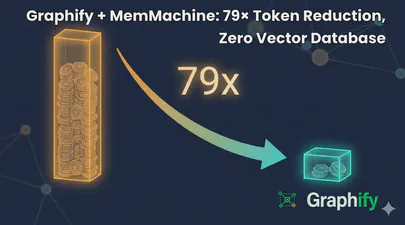
Graphify + MemMachine: 79× Token Reduction, Zero Vector Database
I help maintain MemMachine — an open-source long-term memory layer for AI agents. It’s a real codebase: 442 source files, 171 docs, a graph database, a SQL store, an MCP server, a REST API, a Python SDK, and integrations with eight different agent frameworks. When a new contributor asks “where does episodic memory actually get written?”, grep, the tool of choice for many AI coding assistants, doesn’t cut it. The answer threads through five files in three folders, plus a docker-compose service definition and a Helm chart. Each question you ask, it has to search all of these files, using the LLM to semantically understand the question and the files, then piece together an answer. This can take a lot of tokens and consume much of the context window.
Read More
Self-Hosting Firecrawl on Ubuntu 25.04 with Docker Compose
Modern AI agents — Claude Code, Codex, OpenClaw, Hermes-Agent, and custom LangChain pipelines — need a way to read the web. Not raw HTML full of navigation debris, cookie banners, and JavaScript noise, but clean structured text that a language model can actually reason about. Firecrawl is the missing piece: an open-source web scraping and crawling API that fetches any URL and returns clean Markdown, ready to drop straight into a context window or a RAG pipeline.
Read MoreBuilding an Agentic Team for an Open Source Project with Claude Code
A core engineer on MemMachine — the one who owned the Semantic Memory subsystem — left the project. The codebase didn’t grow any less complex overnight, but the human attention available to maintain it did. That’s a familiar shape of problem in any open source project, and it’s the exact shape where a well-designed Claude Code agent team earns its keep.
This post documents what I built: a 22-agent maintenance team that lives entirely inside MemMachine’s repository, coordinates via Claude Code’s experimental Agent Teams runtime, and operates under a design I can reproduce for any existing repository with real code. The agents don’t push code, don’t sign commits, don’t merge pull requests, and don’t cut releases — humans still gatekeep every consequential action. What the agents do do is the tedious and error-prone middle of software maintenance: triage, spec drafting, implementation, QA, security review, docs, dependency and upstream tracking.
Read More