C

How to Confirm Virtual to Physical Memory Mappings for PMem and FSDAX Files
Are you curious whether your application’s memory-mapped files are really using Intel Optane Persistent Memory (PMem), Compute Express Link (CXL) Non-Volatile Memory Modules (NV-CMM), or another DAX-enabled persistent memory device? Want to understand how virtual memory maps onto physical, non-volatile regions? Let’s use easily adaptable scripts in both Python and C to confirm this on your Linux system, definitively.
Why Does This Matter?
With the advent of persistent memory and DAX (Direct Access) filesystems, applications can memory-map files directly onto PMem, bypassing the traditional DRAM page cache. This promises significant performance and durability improvements for data-intensive workloads and databases, such as SQLite, Redis, and others.
Read More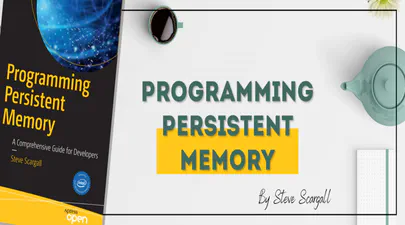
Programming Persistent Memory: A Comprehensive Guide for Developers Book
After many months of hard work by everyone involved, I’m very pleased to announce that the book “Programming Persistent Memory: A Comprehensive Guide for Developers” is now available for download in digital PDF & ePUB formats from https://pmem.io/book , and Kindle & paperback through Amazon .
Beginner and experienced programmers will use this comprehensive guide to persistent memory programming. You will understand how persistent memory brings together several new software/hardware requirements, and offers great promise for better performance and faster application startup times―a huge leap forward in byte-addressable capacity compared with current DRAM offerings.
Read More
This revolutionary new technology gives applications significant performance and capacity improvements over existing technologies. It requires a new way of thinking and developing, which makes this highly disruptive to the IT/computing industry. The full spectrum of industry sectors that will benefit from this technology include, but are not limited to, in-memory and traditional databases, AI, analytics, HPC, virtualization, and big data.
Programming Persistent Memory describes the technology and why it is exciting the industry. It covers the operating system and hardware requirements as well as how to create development environments using emulated or real persistent memory hardware. The book explains fundamental concepts; provides an introduction to persistent memory programming APIs for C, C++, JavaScript, and other languages; discusses RMDA with persistent memory; reviews security features; and presents many examples. Source code and examples that you can run on your own systems are included.
What You’ll Learn
- Understand what persistent memory is, what it does, and the value it brings to the industry
- Become familiar with the operating system and hardware requirements to use persistent memory
- Know the fundamentals of persistent memory programming: why it is different from current programming methods, and what developers need to keep in mind when programming for persistence
- Look at persistent memory application development by example using the Persistent Memory Development Kit (PMDK)
- Design and optimize data structures for persistent memory
- Study how real-world applications are modified to leverage persistent memory
- Utilize the tools available for persistent memory programming, application performance profiling, and debugging
Who This Book Is For
C, C++, Java, and Python developers, but will also be useful to software, cloud, and hardware architects across a broad spectrum of sectors, including cloud service providers, independent software vendors, high performance compute, artificial intelligence, data analytics, big data, etc.