Open Source

Graphify + MemMachine: 79× Token Reduction, Zero Vector Database
I help maintain MemMachine — an open-source long-term memory layer for AI agents. It’s a real codebase: 442 source files, 171 docs, a graph database, a SQL store, an MCP server, a REST API, a Python SDK, and integrations with eight different agent frameworks. When a new contributor asks “where does episodic memory actually get written?”, grep, the tool of choice for many AI coding assistants, doesn’t cut it. The answer threads through five files in three folders, plus a docker-compose service definition and a Helm chart. Each question you ask, it has to search all of these files, using the LLM to semantically understand the question and the files, then piece together an answer. This can take a lot of tokens and consume much of the context window.
Read More
Reflections and What's Next: Lessons from Building lib3mf-rs
Series: Building lib3mf-rs
This post is part of a 5-part series on building a comprehensive 3MF library in Rust:
- Part 1: My Journey Building a 3MF Native Rust Library from Scratch
- Part 2: The Library Landscape - Why Build Another One?
- Part 3: Into the 3MF Specification Wilderness - Reading 1000+ Pages of Specifications
- Part 4: Design for Developers - Features, Flags, and the CLI
- Part 5: Reflections and What’s Next - Lessons from Building lib3mf-rs
On February 4th, 2026, lib3mf-rs is a published open-source project with complete specification coverage, available for anyone to use.
Read More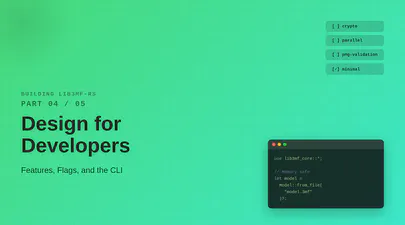
Design for Developers: Features, Flags, and the CLI
Series: Building lib3mf-rs
This post is part of a 5-part series on building a comprehensive 3MF library in Rust:
- Part 1: My Journey Building a 3MF Native Rust Library from Scratch
- Part 2: The Library Landscape - Why Build Another One?
- Part 3: Into the 3MF Specification Wilderness - Reading 1000+ Pages of Specifications
- Part 4: Design for Developers - Features, Flags, and the CLI
- Part 5: Reflections and What’s Next - Lessons from Building lib3mf-rs
Understanding the specifications was one thing. Designing a library that developers would actually want to use? That was another challenge entirely. I’ve worked on many libraries over the years, and I’ve learned a lot about what makes a good library, for example the Persistent Memory Development Kit . The difference is understanding how Rust does things.
Read More
Into the 3MF Specification Wilderness: Reading 1000+ Pages of Specifications
Series: Building lib3mf-rs
This post is part of a 5-part series on building a comprehensive 3MF library in Rust:
- Part 1: My Journey Building a 3MF Native Rust Library from Scratch
- Part 2: The Library Landscape - Why Build Another One?
- Part 3: Into the 3MF Specification Wilderness - Reading 1000+ Pages of Specifications
- Part 4: Design for Developers - Features, Flags, and the CLI
- Part 5: Reflections and What’s Next - Lessons from Building lib3mf-rs
“How hard can it be? It’s just a file format.”
That’s what I thought before I started reading the 3MF specifications. After reading, re-reading, and getting AI to help summarize and dig deeper into the interpretations and understandings, I was ready to begin.
Read More
The Library Landscape: Why Build Another One?
Series: Building lib3mf-rs
This post is part of a 5-part series on building a comprehensive 3MF library in Rust:
- Part 1: My Journey Building a 3MF Native Rust Library from Scratch
- Part 2: The Library Landscape - Why Build Another One?
- Part 3: Into the 3MF Specification Wilderness - Reading 1000+ Pages of Specifications
- Part 4: Design for Developers - Features, Flags, and the CLI
- Part 5: Reflections and What’s Next - Lessons from Building lib3mf-rs
“Why not just use the existing library?”
It’s a fair question. One I asked myself many times during the early days of this project. The 3MF Consortium maintains lib3MF , a comprehensive C++ implementation used by major companies in additive manufacturing. Why build another one?
Read More
My Journey Building a 3MF Native Rust Library from Scratch
For the past few years, I’ve been getting more and more into 3D printing as a hobbyist. Like everyone, I started with one, a Bambu Lab X1 Carbon, which has now grown to three printers. I find the hobby fascinating as it entangles software, firmware, hardware, physics, and materials science.
As a software engineer, I’m naturally drawn to the software side of things (Slicer and Firmware). But what interests me most, is how the software interacts with the hardware and the materials. How the slicer translates the 3D model into instructions for the printer (G-Code). How the printer executes those instructions. How the materials behave under the printer’s control.
Read More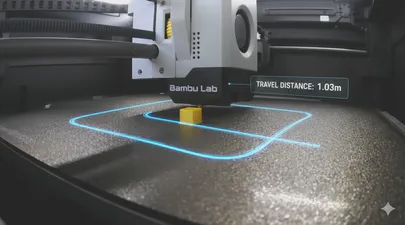
I Added a Feature to OrcaSlicer to Show Travel Distance and Moves
OrcaSlicer is a powerful and popular slicer for 3D printers, known for its rich feature set and active development community. In this blog post, we’ll take a closer look at a new feature I proposed and implemented that provides more insight into your prints: the display of total travel distance and the number of travel moves. See the feat: Display travel distance and move count in G-code summary for more details.
Read More